Overview-
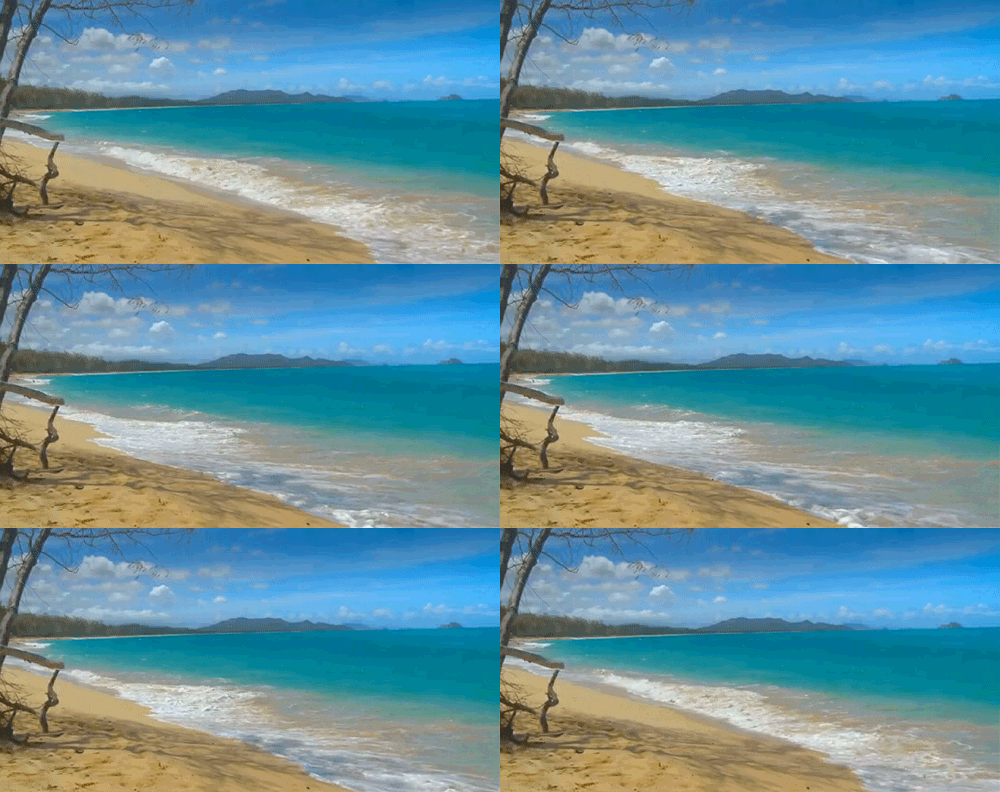
There are several conspicuous parts to a beach that relate to the processes that form and shape it. The part mostly above water (depending upon tide), and more or less actively influenced by the waves at some point in the tide, is termed the beach berm. The berm is the deposit of material comprising the active shoreline. The berm has acrest (top) and a face — the latter being the slope leading down towards the water from the crest. At the very bottom of the face, there may be a trough, and further seaward one or more long shore bars: slightly raised, underwater embankments formed where the waves first start to break.
The sand deposit may extend well inland from the berm crest, where there may be evidence of one or more older crests (the storm beach) resulting from very large storm waves and beyond the influence of the normal waves. At some point the influence of the waves (even storm waves) on the material comprising the beach stops, and if the particles are small enough (sand size or smaller), winds shape the feature. Where wind is the force distributing the grains inland, the deposit behind the beach becomes a dune.
These geomorphic features compose what is called the beach profile. The beach profile changes seasonally due to the change in wave energy experienced during summer and winter months. In temperate areas where summer is characterised by calmer seas and longer periods between breaking wave crests, the beach profile is higher in summer. The gentle wave action during this season tends to transport sediment up the beach towards the berm where it is deposited and remains while the water recedes. Onshore winds carry it further inland forming and enhancing dunes.
Conversely, the beach profile is lower in the storm season (winter in temperate areas) due to the increased wave energy, and the shorter periods between breaking wave crests. Higher energy waves breaking in quick succession tend to mobilise sediment from the shallows, keeping it in suspension where it is prone to be carried along the beach by longshore currents, or carried out to sea to form longshore bars, especially if the longshore current meets an outflow from a river or flooding stream. The removal of sediment from the beach berm and dune thus decreases the beach profile.
In tropical areas, the storm season tends to be during the summer months, with calmer weather commonly associated with the winter season.
If storms coincide with unusually high tides, or with a freak wave event such as a tidal surge or tsunami which causes significant coastal flooding, substantial quantities of material may be eroded from the coastal plain or dunes behind the berm by receding water. This flow may alter the shape of the coastline, enlarge the mouths of rivers and create new deltas at the mouths of streams that formerly were not powerful enough to overcome longshore movement of sediment.
The line between beach and dune is difficult to define in the field. Over any significant period of time, sediment is always being exchanged between them. The drift line (the high point of material deposited by waves) is one potential demarcation. This would be the point at which significant wind movement of sand could occur, since the normal waves do not wet the sand beyond this area. However, the drift line is likely to move inland under assault by storm waves.
Beaches and recreation-
The development of the beach as a popular leisure resort from the mid-19th century was the first manifestation of what is now the global tourist industry. The first seaside resorts were opened in the 18th century for the aristocracy, who began to frequent the seaside as well as the then fashionable spa towns, for recreation and health. One of the earliest such seaside resorts, was Scarborough in Yorkshire during the 1720s; it had been a fashionable spa town since a stream of acidic water was discovered running from one of the cliffs to the south of the town in the 17th century. The first rolling bathing machines were introduced by 1735.
The opening of the resort in Brighton and its reception of royal patronage from King George IV, extended the seaside as a resort for health and pleasure to the much larger London market, and the beach became a centre for upper-class pleasure and frivolity. This trend was praised and artistically elevated by the new romantic ideal of the picturesque landscape; Jane Austen's unfinished novel Sanditonis an example of that. Later, Queen Victoria's long-standing patronage of the Isle of Wight and Ramsgate in Kent ensured that a seaside residence was considered as a highly fashionable possession for those wealthy enough to afford more than one home.
Seaside resorts for the working class-
The extension of this form of leisure to the middle and working class began with the development of the railways in the 1840s, which offered cheap and affordable fares to fast growing resort towns. In particular, the completion of a branch line to the small seaside town Blackpool from Poulton led to a sustained economic and demographic boom. A sudden influx of visitors, arriving by rail, provided the motivation for entrepreneurs to build accommodation and create new attractions, leading to more visitors and a rapid cycle of growth throughout the 1850s and 1860s.
The growth was intensified by the practice among the Lancashire cotton mill owners of closing the factories for a week every year to service and repair machinery. These became known as wakes weeks. Each town's mills would close for a different week, allowing Blackpool to manage a steady and reliable stream of visitors over a prolonged period in the summer. A prominent feature of the resort was thepromenade and the pleasure piers, where an eclectic variety of performances vied for the people's attention. In 1863, theNorth Pier in Blackpool was completed, rapidly becoming a centre of attraction for elite visitors. Central Pier was completed in 1868, with a theatre and a large open-air dance floor.
Many of the popular beach resorts were equipped with bathing machines because even the all-covering beachwear of the period was considered immodest. By the end of the century the English coastline had over 100 large resort towns, some with populations exceeding 50,000.

Expansion around the world-
The development of the seaside resort abroad was stimulated by the well developed English love of the beach. The French Riviera alongside theMediterranean had already become a popular destination for the British upper class by the end of the 18th century. In 1864, the first railway to Nice was completed, making the Riviera accessible to visitors from all over Europe. By 1874, residents of foreign enclaves in Nice, most of whom were British, numbered 25,000. The coastline became renowned for attracting the royalty of Europe, including Queen Victoria and King Edward VII.
Continental European attitudes towards gambling and nakedness tended to be more lax than in Britain, so British and French entrepreneurs were quick to exploit the possibilites. In 1863, the Prince of Monaco, Charles III and François Blanc, a French businessman, arranged for steamships and carriages to take visitors from Nice to Monaco, where large luxury hotels, gardens and casinos were built. The place was renamed Monte Carlo.
Commercial seabathing also spread to the United States and parts of the British Empire such as Australia where surfing was developed in the early 20th century. By the 1970s cheap and affordable air travel was the catalayst for the growth of a truly global tourism market which benefited areas such as the Spain and the South of France with sunny climates.

Today-
on warm sunny days. In the Victorian era, many popular beach resorts were equipped with bathing machines because even the all-covering beachwear of the period was considered immodest. This social standard still prevails in many Muslim countries. In most countries social norms are significantly different on a beach in hot weather, compared to adjacent areas where similar behaviour might not be tolerated and might even be prosecuted.
In more than thirty countries in Europe, South Africa, New Zealand, Canada, Costa Rica, South America and the Caribbean, the best recreational beaches are awarded Blue Flag status, based on such criteria as water quality and safety provision. Subsequent loss of this status can have a severe effect on tourism revenues.
Beaches are often dumping grounds for waste and litter, necessitating the use of beach cleaners and other cleanup projects. More significantly, many beaches are a discharge zone for untreated sewage in most underdeveloped countries; even in developed countries beach closure is an occasional circumstance due to sanitary sewer overflow. In these cases of marine discharge, waterborne disease from fecal pathogens and contamination of certain marine species is a frequent outcome.
Artificial Beaches-
Some beaches are artificial; they are either permanent or temporary (For examples see Monaco, Paris, Copenhagen, Rotterdam, Nottingham, Toronto, Hong Kong,Singapore, and Tianjin).
The soothing qualities of a beach and the pleasant environment offered to the beachgoer are replicated in artificial beaches, such as "beach style" pools with zero-depth entry and wave pools that recreate the natural waves pounding upon a beach. In a zero-depth entry pool, the bottom surface slopes gradually from above water down to depth. Another approach involves so-called urban beaches, a form of public park becoming common in large cities. Urban beaches attempt to mimic natural beaches with fountains that imitate surf and mask city noises, and in some cases can be used as a play park.
Beach nourishment involves pumping sand onto beaches to improve their health. Beach nourishment is common for major beach cities around the world; however the beaches that have been nourished can still appear quite natural and often many visitors are unaware of the works undertaken to support the health of the beach. Such beaches are often not recognized (by consumers) as artificial. The Surfrider Foundation has debated the merits of artificial reefs with members torn between their desire to support natural coastal environments and opportunities to enhance the quality of surfing waves. Similar debates surround beach nourishment and snow cannon in sensitive environments.

Beach Information-
Beaches are the result of wave action by which waves orcurrents move sand or other loose sediments of which the beach is made as these particles are held insuspension. Alternatively, sand may be moved bysaltation (a bouncing movement of large particles).
Beach materials come from erosion of rocks offshore, as well as from headland erosion and slumping producing deposits of scree. Some of the whitest sand in the world, along Florida's Emerald Coast, comes from the erosion of quartz in the Appalachian Mountains.
A coral reef offshore is a significant source of sand particles. Some species of fish that feed on algae attached to coral outcrops and rocks can create substantial quantities of sand particles over their lifetime as they nibble during feeding, digesting the organic matter, and discarding the rock and coral particles which pass through their digestive tracts.
The composition of the beach depends upon the nature and quantity of sediments upstream of the beach, and the speed of flow and turbidity of water and wind.
Sediments are moved by moving water and wind according to their particle size and state of compaction. Particles tend to settle and compact in still water. Once compacted, they are more resistant to erosion. Established vegetation (especially species with complex network root systems) will resist erosion by slowing the fluid flow at the surface layer.
When affected by moving water or wind, particles that are eroded and held in suspension will increase the erosive power of the fluid that holds them by increasing the average density, viscosity and volume of the moving fluid.
The nature of sediments found on a beach tends to indicate the energy of the waves and wind in the locality. Coastlines facing very energetic wind and wave systems will tend to hold only large rocks as smaller particles will be held in suspension in the turbid water column and carried to calmer areas by longshore currents and tides. Coastlines that are protected from waves and winds will tend to allow finer sediments such as clays and mud to precipitate creating mud flats and mangrove forests.
The shape of a beach depends on whether the waves are constructive or destructive, and whether the material is sand or shingle.
Waves are constructive if the period between their wave crests is long enough for the breaking water to recede and the sediment to settle before the succeeding wave arrives and breaks. Fine sediment transported from lower down the beach profile will compact if the receding water percolates or soaks into the beach. Compacted sediment is more resistant to movement by turbulent water from succeeding waves.
Conversely, waves are destructive if the period between the wave crests is short. Sediment that remains in suspension when the following wave crest arrives will not be able to settle and compact and will be more susceptible to erosion by longshore currents and receding tides.
Constructive waves move material up the beach while destructive waves move the material down the beach. During seasons when destructive waves are prevalent, the shallows will carry an increased load of sediment and organic matter in suspension.
On sandy beaches, the turbulent backwash of destructive waves removes material forming a gently sloping beach. On pebble and shingle beaches the swash is dissipated more quickly because the large particle size allows greater percolation, thereby reducing the power of the backwash, and the beach remains steep.
Compacted fine sediments will form a smooth beach surface that resists wind and water erosion. During hot calm seasons, a crust may form on the surface of ocean beaches as the heat of the sun evaporates the water leaving the salt which crystallises around the sand particles. This crust forms an additional protective layer that resists wind erosion unless disturbed by animals, or dissolved by the advancing tide.
Cusps and horns form where incoming waves divide, depositing sand as horns and scouring out sand to form cusps. This forms the uneven face on some sand shorelines.
.gif?timestamp=1531028459363)
Destruction of Flora-
Beach front flora plays a major role in stabilizing the foredunes and preventing beach head erosion and inland movement of dunes. If flora with network root systems (creepers, grasses and palms) are able to become established, they provide an effective coastal defense as they trap sand particles and rainwater and enrich the surface layer of the dunes, allowing other plant species to become established. They also protect the berm from erosion by high winds, freak waves and subsiding flood waters.
Over long periods of time, well stabilized foreshore areas will tend to accrete, while unstabilized foreshores will tend to erode, leading to substantial changes in the shape of the coastline. These changes usually occur over periods of many years. Freak wave events such as tsunami, tidal waves, and storm surges may substantially alter the shape, profile and location of a beach within hours.
Destruction of flora on the berm by the use of herbicides, excessive pedestrian or vehicular traffic, or disruption to fresh water flows may lead to erosion of the berm and dunes. While the destruction of flora may be a gradual process that is imperceptible to regular beach users, it often becomes immediately apparent after storms associated with high winds and freak wave events that can rapidly move large volumes of exposed and unstable sand, depositing them further inland, or carrying them out into the permanent water forming offshore bars, lagoons or increasing the area of the beach exposed at low tide.
Large and rapid movements of exposed sand can bury and smother flora in adjacent areas, aggravating the loss of habitat for fauna, and enlarging the area of instability. If there is an adequate supply of sand, and weather conditions do not allow vegetation to recover and stabilize the sediment, wind-blown sand can continue to advance, engulfing and permanently altering downwind landscapes.
Sediment moved by waves or receding flood waters can be deposited in coastal shallows, engulfing reed beds and changing the character of underwater flora and fauna in the coastal shallows.
Burning or clearance of vegetation on the land adjacent to the beach head, for farming and residential development, changes the surface wind patterns, and exposes the surface of the beach to wind erosion.
Farming and residential development are also commonly associated with changes in local surface water flows. If these flows are concentrated in storm water drains emptying onto the beach head, they may erode the beach creating a lagoon or delta.
Dense vegetation tends to absorb rainfall reducing the speed of runoff and releasing it over longer periods of time. Destruction by burning or clearance of the natural vegetation tends to increase the speed and erosive power of runoff from rainfall. This runoff will tend to carry more silt and organic matter from the land onto the beach and into the sea. If the flow is constant, runoff from cleared land arriving at the beach head will tend to deposit this material into the sand changing its color, odor and fauna.